The Early Tao of the Hidden Recluse
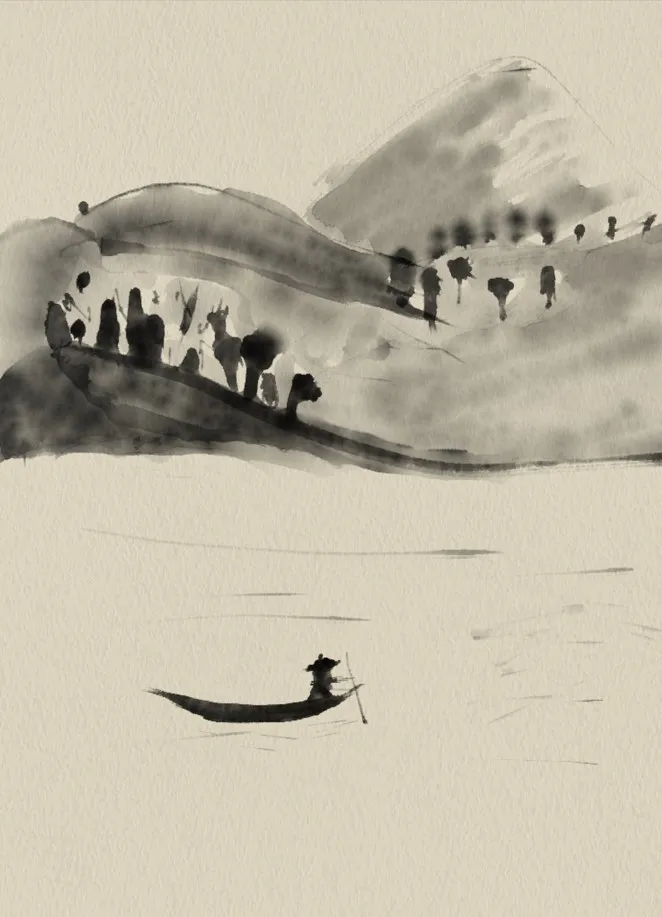
Ink Painting "Fishing Boat on a Lake" by A Wayfarer.
Before Taoism became an ism. At a time when Taoists were not ists. Such people were given different names to describe them, and they differed in their approach…
Fangshi (方士): meaning “master of methods” or “recipe gentlemen”. These were specialists in occult arts, alchemy, and longevity techniques who provided the practical and “magical” foundations for later religious Taoism.
Zhenren (真人): Meaning “True Person” or “Perfected Person”. This was an idealised title used in the Zhuangzi to describe someone who had achieved complete harmony with the Tao.
Daoshi (道士): While this later became the standard term for a Taoist priest, in early pre-Han (c. 200 BCE) contexts, it simply referred to a “Master of the Way” or a practitioner of self-cultivation.
Xian (仙): This term referred specifically to “Immortals“ or “transcendents”, those believed to have attained eternal life through Taoist disciplines.
Huang-Lao Practitioners: In the early Han, many were simply identified by the Huang-Lao tradition (named after the Yellow Emperor and Laozi), which was the dominant intellectual and political movement of the time
Yinshi (隐士), meaning “hidden scholars“ or “recluses,” was a common term used for early practitioners:
• The Recluses: Figures like Yang Zhu (c. 400 BCE) were described as Yinshi because they “hid themselves” from society, rejecting political life in favour of personal cultivation and simplicity.
• Literary Usage: The term appeared in early texts like the Analects of Confucius, where these recluses were often portrayed as ridiculing Confucius’s active efforts to change the world.
The Way of the Yinshi
In the era before Taoism became a religion (pre-100 BCE), the Yinshi (recluse) was essentially a Philosophical Individualist. They weren’t interested in “magic” or gods; they were interested in Integrity / Virtue (Te) and Spontaneity / Being as being is (Ziran).
This figure is best represented by the “Old Masters” of the Zhuangzi and the Neiye. Their “technique” wasn’t a ritual, but a state of being.
The Core “Hidden” Practices
If you strip away the later religious “magic,” the original practice of the Yinshi focused on three psychological and physiological shifts:
Xu (虛): Instead of “filling” themselves with knowledge or power, they sought to “empty” the mind. They believed that when the mind is empty of social conditioning and desire, the Tao naturally flows into it like water into a basin.
Shouyi (守一) Guarding the One: A simple and early version of Neidan before it became quite complicated. Although some Yinshi would have liked a complex practice to occupy their time, it wasn’t about “internal alchemy” in a complex chemical sense; it was simply about maintaining a singular, unbroken focus on the Source (the One) within the body, preventing their vital energy (Qi) from leaking out through worldly distractions.
Xinzhai (心齋)“Purifying the Mind”: This is the “silence” of Being. As described in the Zhuangzi, it is the practice of listening not with the ears, or even the mind, but with the Qi itself. It is a total sensory withdrawal that allows one to perceive the “unheard” harmony of the universe.
The Character of the Pre-Religious Yinshi
• Anonymity: To these early practitioners, fame and social status were “shackles.” They believed that to be “useful” to society was to be used up. By remaining “useless” (like the gnarled tree no carpenter wants to cut - Chuang Tzu), they preserved their life and their connection to the Tao.
• The “Uncarved Block” (Pu): Their goal was to return to a state of “primitive simplicity.” They sought to undo their education and social training until they were as simple and responsive as an uncarved piece of wood.
• Silence over Scripture: They were deeply skeptical of words. This is why the Tao Te Ching begins by saying the “Tao that can be told is not the eternal Tao.” For a Yinshi, the “Scripture” was the natural world and their own internal rhythm, not a book.
This version of the “Taoist” was essentially a Naturalist-Mystic, someone who believed that the deepest truth is found by stripping away the “artificial” layers of human civilization to reveal the “original” nature beneath.
Forest Scripture
To read the stillness of a forest is to read scripture. To read, as a Yinshi, is to feel not only with the senses, but with energy, and also internally, in the inner cauldron of the stillness that is also there. The “scholarly” aspect of the Yinshi is not found in books, but is the knowing of a deep wisdom of the way of the universe.
To consider our own internal rhythm with that of the outer, the forest (or meadows, mountains, lakes, and rivers - i.e., wild nature) is to begin to see how they are the same, for we are the same wild nature. The One on the outside is the same as the One on the inside.
The Cistercian Abbot, Saint Bernard of Clairvaux, said, “Believe me, you will find more lessons in the woods than in books. Trees and stones will teach you what you cannot learn from masters.”
It is to notice what is hidden in plain sight. A Yinshi withdrew into obscurity to notice the hidden. The forest expresses Settledness. The sound of a waterfall silences the mind rather than causing agitation.
When we see the Stillness, feel the Settledness, and hear the Silence (within silence and noise), we follow the hidden practices of the Yinshi. We turn away from Yang (creation and its disturbing energies/manifestations) and face Yin. We live as the Uncarved purity of wildness, and bathe in the Silent waters of Presence.
This is the Way of Yin.
To live the Tao in this way is to follow a hidden lineage, a long line of cave-dwellers, mountain hermits, and Taoist poets whose paths entered the mists of Tao throughout time.
A. Wayfarer